

Written by
ishiom Appiah-Yeboah
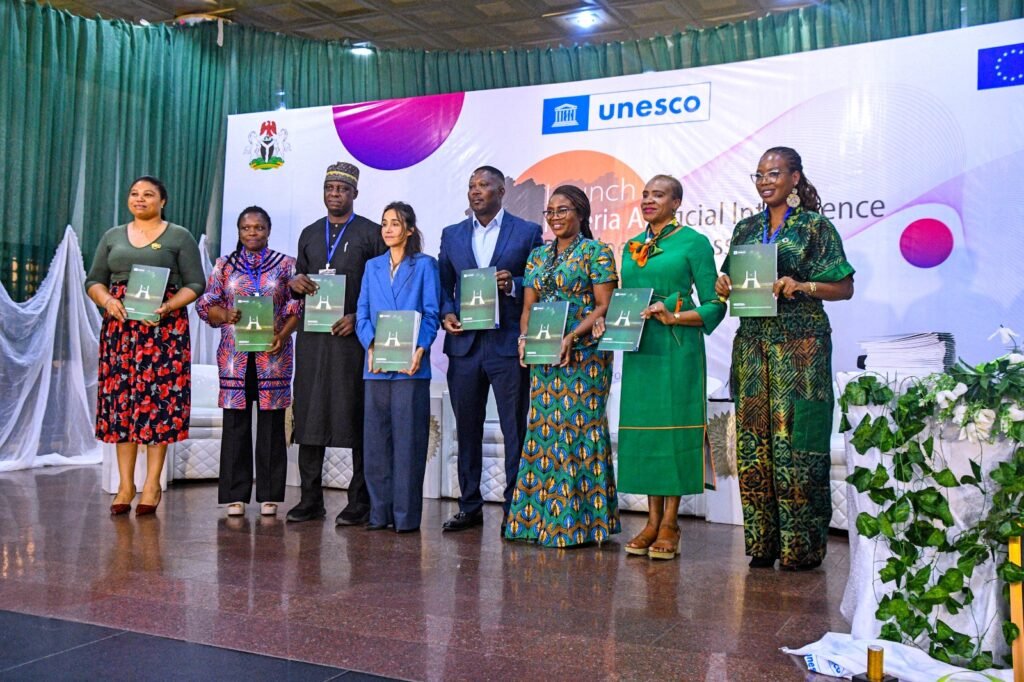
Nigeria’s ambition to become Africa’s leading artificial intelligence hub received a major boost on Tuesday as UNESCO and the European Union (EU) unveiled the country’s Artificial Intelligence Readiness Assessment Report, providing the most comprehensive roadmap yet for ethical AI adoption, innovation, and governance.
The report, launched in Abuja, comes at a critical moment when artificial intelligence is reshaping economies, industries, and governments worldwide. From healthcare and agriculture to education, finance, security, and public service delivery, AI is increasingly becoming the technology powering the next wave of global economic growth.
For Nigeria, Africa’s largest economy and home to more than 220 million people, the assessment offers both a reality check and a blueprint for the future.
Speaking at the unveiling on behalf of UNESCO’s Officer-in-Charge in Abuja, Dr. Dimitri Sanga, UNESCO Head of Finance and Administration, Fatu Comfort Sumo, described the report as a landmark step toward building a human-centred AI ecosystem capable of driving sustainable development while protecting fundamental rights.
“Artificial intelligence is now woven into every aspect of modern life. The readiness assessment provides a diagnostic tool that shows where Nigeria stands today and what must be done to ensure AI remains ethical, inclusive and beneficial to all citizens,” he said.
Nigeria’s AI Journey Gains Momentum
One of the report’s most notable findings is Nigeria’s AI Readiness Score of 47.9, placing the country within the emerging category of nations actively building the foundations required for large-scale AI adoption.
Even more impressive is Nigeria’s ICT Regulatory Maturity Score of 92, one of the highest on the African continent, reflecting significant progress in policy development, digital governance, and regulatory oversight.
According to Ikram Tolba, Programme Officer for Green and Digital Economy at the EU Delegation to Nigeria and ECOWAS, Nigeria already possesses many of the ingredients required to become a continental AI leader.
“The challenge is no longer vision, regulation or talent. The key bottlenecks are infrastructure and access to capital,” Tolba noted.
The assessment identified governance, regulation, digital skills, and innovation capacity as emerging strengths, while infrastructure, computing power, and financing remain critical areas requiring urgent investment.
EU Deepens Investment in Nigeria’s Digital Economy
To address those gaps, the European Union announced plans to strengthen partnerships with Nigeria across research, digital infrastructure, skills development, and AI governance.
The EU revealed that its Digital Economy Package for Nigeria, launched in 2022, is expected to reach €860 million in grants and loans by 2025, supporting investments in digital infrastructure, digital identity systems, e-government services, connectivity, and workforce development.
European technology firms including AI and cloud-computing companies are also exploring partnerships with Nigerian institutions as demand for AI capabilities continues to grow.
The investment is expected to accelerate Nigeria’s efforts to build local AI infrastructure and reduce dependence on foreign technology ecosystems.
AI Could Help Nigeria Leapfrog Decades of Development Challenges
Representing the Minister of Communications, Innovation and Digital Economy, Dr. Bosun Tijani, the National Director of the National Centre for Artificial Intelligence and Robotics (NCAIR), Dr. Bunmi Ajala, said AI presents Nigeria with a unique opportunity to bypass traditional development limitations.
“We are living through one of the most significant technological transitions in modern history. AI has become a foundational technology similar to electricity during the Industrial Revolution and the internet during the digital revolution,” he said.
According to him, artificial intelligence could significantly improve productivity, create jobs, strengthen government services, boost national competitiveness, and expand economic opportunities across sectors.
He noted that Nigeria’s readiness for AI depends largely on what experts call “absorption capacity” the ability to adopt, adapt, and extract value from emerging technologies.
Massive Investments in Talent and Infrastructure
Over the past three years, Nigeria has launched a series of initiatives aimed at strengthening its AI foundations.
Among them is Project BRIDGE, an ambitious programme targeting the deployment of 90,000 kilometres of fibre-optic infrastructure, one of the largest connectivity expansion projects in Africa.
The government is also implementing the 3 Million Technical Talent (3MTT) Programme, designed to build one of the world’s largest pools of digital talent and prepare young Nigerians for emerging technology jobs.
In addition, UNESCO disclosed that with EU support, over 400 civil servants across six Nigerian states have already undergone AI literacy and capacity-building training to improve public-sector understanding of artificial intelligence and responsible technology governance.
The combination of talent development, policy reforms, and infrastructure expansion is expected to strengthen Nigeria’s competitiveness in the rapidly growing global AI economy.
Why This Report Matters to Nigerians
Beyond the technology sector, the assessment has far-reaching implications for everyday Nigerians.
Stakeholders at the event say responsible AI adoption could Improve healthcare diagnostics and patient care, Increase agricultural productivity through smart farming solutions, Enhance learning outcomes in schools, Improve government service delivery, Expand access to financial services, Create new jobs in technology and digital industries, Support national security and public safety initiatives.
The report evaluates Nigeria across multiple dimensions including governance, infrastructure, education, research, innovation, ethics, legal frameworks, social inclusion, and economic participation.
Data Protection Emerges as a Key AI Priority
A recurring theme throughout the launch was the importance of data governance and privacy.
Dr Vincent Olatunji, National Commissioner of the Nigeria Data Protection Commission (NDPC) emphasised that AI readiness cannot be separated from data protection, cybersecurity, and responsible innovation.
Represented by the Head of Innovation at the Commission Adaobi Nwankwo , he noted that the Nigeria Data Protection Act provides a legal framework for protecting personal information, promoting trust, and ensuring AI systems operate responsibly.
As AI becomes increasingly involved in decision-making processes, experts warned that safeguards will be essential to prevent bias, discrimination, unlawful profiling, and misuse of personal data.
Government technology services provider Galaxy Backbone Limited disclosed that it currently operates critical national data centres and more than 5,000 kilometres of fibre infrastructure nationwide, with plans to expand connectivity and cloud capacity to support growing AI demands.
The launch of the UNESCO AI Readiness Assessment Report marks more than the release of a policy document.
It signals Nigeria’s determination to build an AI ecosystem grounded in innovation, ethics, inclusion, and economic opportunity.
With a readiness score of 47.9, a regulatory maturity score of 92, over 400 public officials already trained in AI literacy, a planned 90,000-kilometre fibre expansion programme, and €860 million in EU-backed digital investments, stakeholders believe the foundations are being laid for Nigeria to emerge as one of Africa’s most influential AI economies.
For government, industry, academia, and citizens alike, the message from the report is clear: the future of artificial intelligence in Nigeria will not be defined solely by technology, but by the country’s ability to build the infrastructure, skills, trust, and governance needed to ensure AI works for everyone.