
A threatening message, a leaked private photograph, relentless online stalking or a cruel comment may take only seconds to post, but for victims, the consequences can last for months or even years.
For many Nigerians, the internet has become an essential part of everyday life a place to work, run businesses, study, speak out and maintain relationships.
But for women and girls with disabilities and other vulnerable groups, the same digital space can increasingly become a place of harassment, humiliation, discrimination and fear.
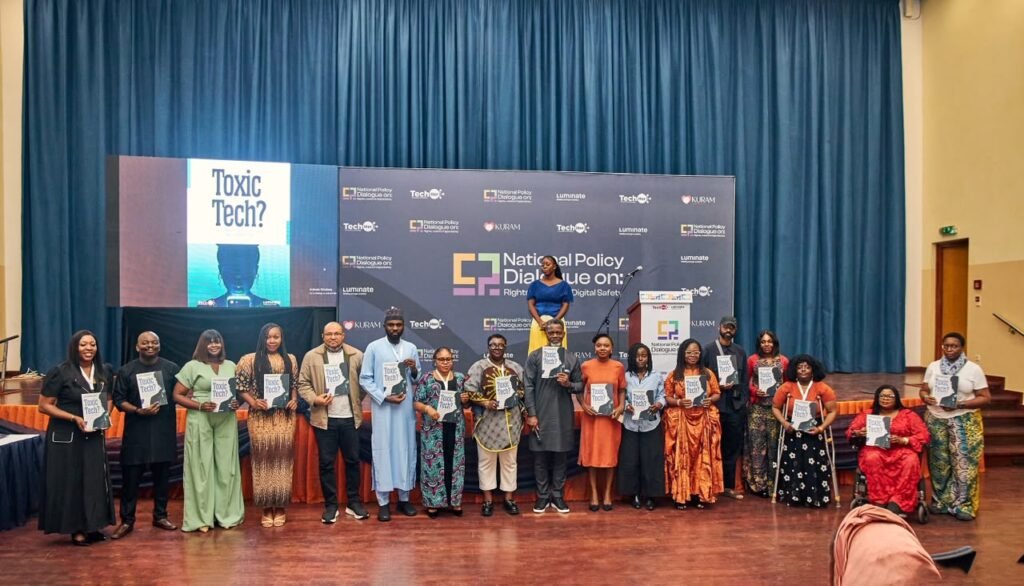
This was at the centre of discussions at a National Policy Dialogue on Rights, Justice and Digital Safety, where TechHer unveiled its latest report, “Toxic Tech: Understanding and Addressing Online Violence Against Vulnerable Groups.”
The report examines the growing problem of technology-facilitated gender-based violence and how it affects people differently depending on their gender, disability and other vulnerabilities.
‘Online violence has offline consequences’
Head of Programmes at TechHer, Peter Akinusi, said the organisation undertook the research to better understand the nature of online threats, who is most affected and how victims can access justice.
According to him, digital violence is not confined to the internet.
He explained that people who are stalked, doxxed or abused online can eventually face physical consequences offline.
Akinusi said the study found that persons with disabilities can face a “double vulnerability” because many digital platforms are not sufficiently designed to accommodate their needs, while they may also face targeted abuse because of their disability.
“ Issues such as font sizes, colours, content presentation and accessibility features can make digital platforms difficult to navigate for persons with disabilities” he explained
Beyond accessibility, the report found that vulnerable people can face abuse precisely because of who they are.
A woman with a disability, for instance, may not only be targeted because she is a woman but also because she belongs to another vulnerable group.
Akinusi said platforms cannot be designed on a “one-size-fits-all” basis because users experience technology differently.
He said the experience of a woman online can differ from that of a man, while a woman with a disability may face entirely different barriers and risks.
The cost of seeking justice
For victims who decide to fight back, however, getting justice can come at a steep financial cost.
Akinusi said some respondents who attempted to pursue justice after experiencing online harm spent between ₦50,000 and ₦100,000.
According to him , the cost can be overwhelming for a low-income victim. In practical terms, someone earning around Nigeria’s minimum wage could be forced to spend a substantial part of an entire month’s income simply to seek redress for an abuse that began with a phone or computer screen.
For many victims, that financial burden can become another reason to remain silent.
Women with disabilities face heightened risks
Executive Director of the Inclusive Friends Association, Grace Jeremy Shelia, said women and girls with disabilities can experience violence at significantly higher levels than women generally.
She stressed that efforts to tackle violence must directly involve the communities most affected.
According to her, organisations representing persons with disabilities must be part of the development of policies, interventions and reporting mechanisms designed to protect women and girls with disabilities.
She also called for greater digital literacy among vulnerable groups so they can recognise abusive and discriminatory behaviour, understand their digital rights and know where to report violations.
For her, the issue is not simply about stopping abuse but ensuring that victims can obtain justice.
Policy must drive action — UK National Crime Agency
Representative of the UK National Crime Agency and British High Commission in Nigeria, Matthew Mountain, said effective policy is critical to protecting vulnerable victims and enabling law enforcement agencies to respond effectively.
He noted that technology-facilitated gender-based violence and financially motivated sexual extortion are often underreported.
According to him, improving reporting is essential because it gives law enforcement agencies the information needed to identify perpetrators and pursue justice.
Mountain, however, cautioned against simply importing foreign solutions into Nigeria.
He said lessons and best practices from other countries should be adapted to Nigeria’s unique social, legal and cultural context.
Protecting citizens without restricting their rights
The discussion also highlighted the difficult balance between regulating harmful online behaviour and protecting fundamental freedoms.
Tari Wills who represented Toyin Akinniyi, the Luminate vice-president in Africa, said government must work with civil society organisations, technology companies and other stakeholders to address online harms without unnecessarily infringing on rights such as freedom of expression, association and access to information.
She argued that collaboration is essential to developing effective solutions.
Tech companies urged to redesign platforms
TechHer is also calling on technology companies to make digital platforms more inclusive and accessible.
The organisation is therefore advocating stronger legal and regulatory frameworks, better implementation of existing protections, more inclusive technology design and stronger collaboration between government and civil society.
TechHer also operates KURAM, a reporting and response platform intended to help victims of violence report incidents and access legal support.
Making the internet safer for everyone
The message from the dialogue is increasingly difficult to ignore: online violence is not virtual simply because it happens on a screen.
As more Nigerians rely on the internet for work, education, business and communication, stakeholders say digital safety must become an integral part of protecting citizens’ rights.