
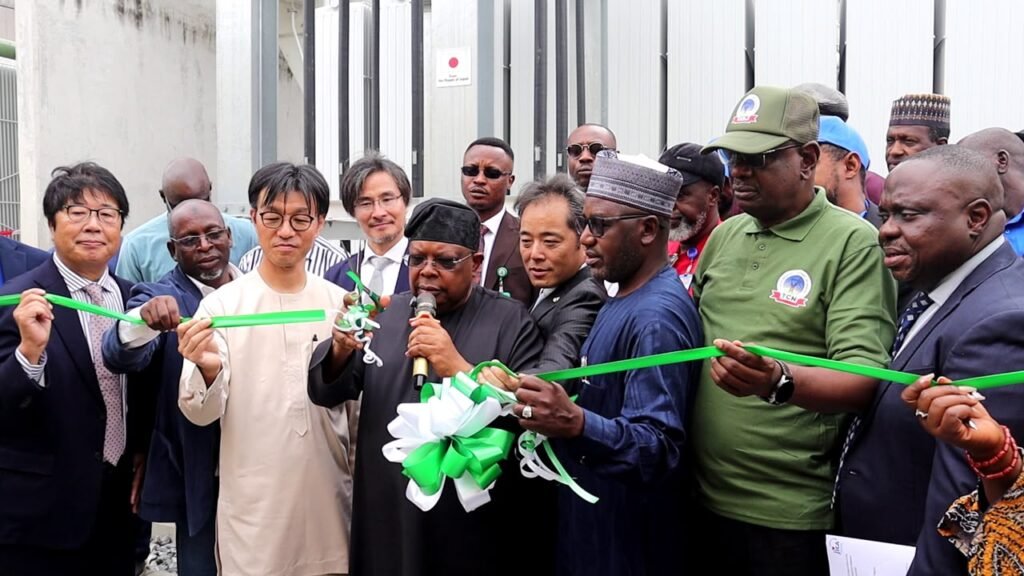
The Federal Government has commissioned two upgraded transmission substations in Lagos, adding a combined 208 megawatts of bulk transmission capacity to the national grid and strengthening electricity supply to some of the country’s busiest commercial and industrial areas.
The upgraded facilities are located at Ijora and Apapa Road, two strategic points serving major economic corridors in Lagos.
At Ijora, the installation of two new 100MVA transformers has increased the substation’s capacity from 90MVA to 230MVA, representing an additional 112 megawatts.
At Apapa Road, a new Gas Insulated Substation (GIS) has added another 96 megawatts, replacing an outdoor transformer that had served as a temporary solution after the original facility, commissioned in 1985, was decommissioned.
Commissioning the projects on Monday, Minister of Power, Joseph Tegbe, said the upgrades demonstrate the administration’s determination to tackle years of transmission bottlenecks and infrastructure challenges that have limited electricity delivery across the country.
Tegbe said the projects reflect President Bola Ahmed Tinubu’s “fearless commitment” to addressing structural constraints holding back economic growth, adding that a stronger power transmission network is critical to the administration’s ambition of building a one-trillion-dollar economy.
He also commended the Lagos State Government for its support, assuring that the Ministry of Power would continue to strengthen transmission infrastructure across the country.
According to the Minister, improving transmission capacity is essential to closing the gap between electricity generated and the amount that can actually be evacuated and delivered to consumers.
At the Apapa facility, the Managing Director and Chief Executive Officer of the Transmission Company of Nigeria, Engr. Sule Ahmed Abdulaziz, said the installation and energisation of two new 60MVA transformers and modern GIS equipment had tripled the substation’s capacity from 60MVA to 180MVA.
He said the Ijora substation now has a capacity of 230MVA, with the combined upgrades expected to increase the bulk electricity available to the Eko Electricity Distribution Company for onward distribution to several critical areas.
These include Apapa Causeway, Ijora, Amukoko, Ajegunle, Apapa Wharf and Tin Can Island, among other commercial and industrial locations.
Abdulaziz described the projects, sponsored by the Japan International Cooperation Agency (JICA) and the World Bank, in partnership with TCN, as a major step towards modernising Nigeria’s transmission network and improving grid stability.
He called for continued support from development partners, particularly through grant funding, to enable TCN to address other critical gaps across the transmission network.
The commissioning ceremonies were attended by senior government officials, representatives of the Japanese Government and JICA, the Permanent Secretary of the Ministry of Power, the Chief Executive Officer of the Nigerian Independent System Operator, representatives of the Lagos State Government, as well as officials of the Eko and Ikeja electricity distribution companies.
The Federal Government says the upgraded facilities are expected to improve the reliability of bulk power supply to Lagos and strengthen electricity delivery to businesses, industries and communities within the served corridors.