
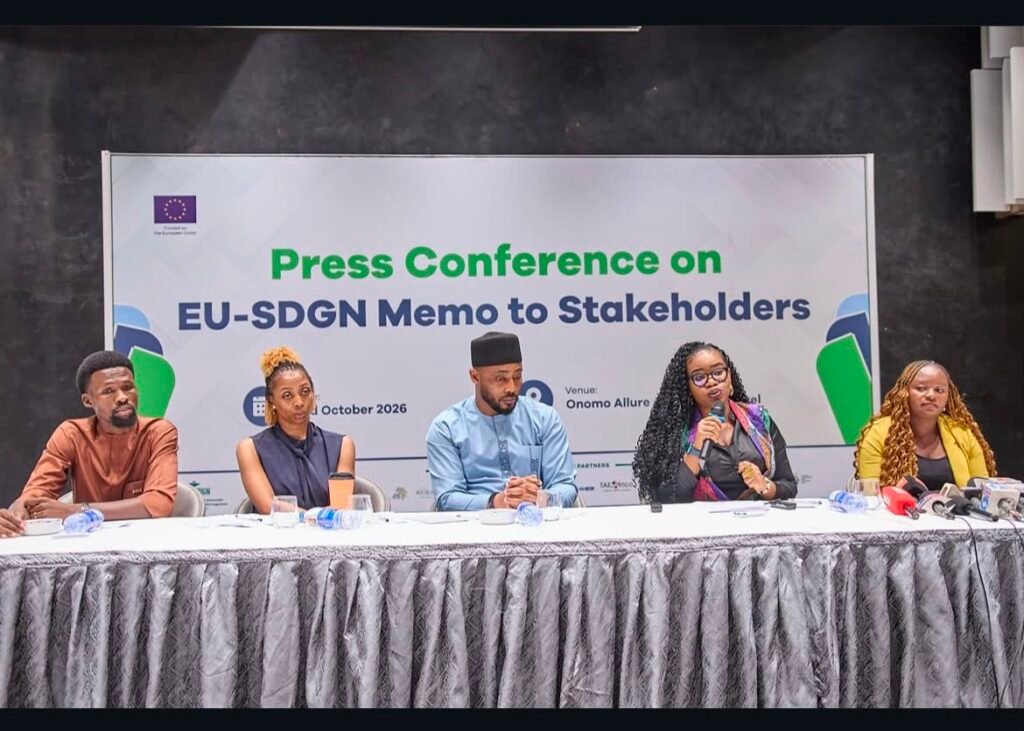
Six civil society organisations have challenged the Independent National Electoral Commission (INEC) to go beyond assurances and provide Nigerians with verifiable evidence that its systems and preparations are ready for the 2027 general elections.
The groups made the call in Abuja at a media briefing on “Rising Concerns Ahead of the 2027 General Election: An Urgent Call for Action.”
Speaking on behalf of the organisations, Programme Manager of Yiaga Africa, Cynthia Mbamalu, urged the Federal Government to release adequate funds to INEC on time, stressing that effective electoral planning, procurement and logistics depend on timely funding.
The organisations also placed particular emphasis on election technology, result management and lessons from the 2023 general election.
The demand is contained in an open memorandum endorsed by the Centre for Media and Society, International Press Centre, Nigerian Women Trust Fund, TAF Africa, The Kukah Centre and Yiaga Africa.
With the Presidential and National Assembly elections scheduled for January 16, 2027, the groups said the period ahead of the polls should be used to provide Nigerians with measurable evidence of preparedness rather than general assurances.
They urged INEC to publish regular and verifiable updates on its operational readiness, saying public confidence in the electoral process must be built on evidence that citizens can inspect.
Spotlight on BVAS and IReV
A major concern raised by the organisations is the reliability of the technologies that will underpin voter accreditation and results management.
They want INEC to conduct and publish the results of stress tests on the Bimodal Voter Accreditation System (BVAS) and the INEC Result Viewing portal (IReV), with the exercises designed in a way that can be independently verified.
The CSOs also want the Commission to clearly explain how the Electoral Act 2026 and its regulations and guidelines will govern voter accreditation, polling-unit result management, collation and publication of results, including the use of the electronic Form EC8A.
They are particularly seeking proof that the technical problem that affected the uploading of presidential polling-unit results to IReV during the 2023 general election has been resolved.
The groups want INEC to publish verifiable evidence that the problem has been rectified, with the improvements further subjected to independent observation during the Commission’s planned mock accreditation exercise.
They also called for clear fallback procedures in the event of technology failures, as well as audit trails showing how corrections or delayed uploads of election results are handled.
CSOs seek public election-readiness dashboard
Beyond technology, the organisations want INEC to publish a dated readiness dashboard that would allow Nigerians to track preparations for the polls.
The dashboard, they said, should cover election funding, procurement milestones, delivery and storage of sensitive and non-sensitive materials, secure distribution and contingency arrangements for areas affected by insecurity or infrastructure challenges.
The groups also want the Commission to disclose recruitment requirements, the number of personnel needed and engaged, training schedules, deployment plans and welfare arrangements for ad hoc election staff.
They called for the early filling of vacancies in critical leadership and technical positions to strengthen institutional capacity and ensure operational continuity.
The organisations further urged INEC to issue regular public readiness reports containing measurable indicators, responsible officials and deadlines.
PVC collection also under scrutiny
The CSOs asked INEC to publish detailed guidelines for the collection and distribution of Permanent Voter Cards, including the logistics and personnel to be deployed.
They said clearer planning was needed to prevent delays that could leave eligible voters unable to participate in the election.
They also asked the Commission to clarify arrangements for downloadable voter cards and provide clear guidance on how they would apply during the general election.
Political parties, security agencies get demands
The memorandum also places responsibilities on political parties, candidates, security agencies, the media, religious and community leaders, the judiciary and civil society.
Political parties and candidates were urged to reject hate speech, ethnic and religious incitement, threats, coercion, vote buying and obstruction of lawful political activities.
The organisations also warned against using the advantages of incumbency to restrict opposition parties’ access to campaign venues, outdoor advertising spaces and other shared resources.
On security, the CSOs called on the Nigeria Police Force and other security agencies to publish a coordinated election-security framework covering threat assessments, risk mitigation, command responsibilities, rules of engagement, protection of vulnerable communities and rapid-response and complaints mechanisms.
They stressed that security personnel must act impartially and should not be used as instruments of partisan coercion.
The media was urged to provide equitable, issue-based coverage, distinguish journalism from sponsored content, verify viral claims before amplification and prominently correct errors.
Religious, traditional and community leaders were asked to reject violence, exclusion and collective blame, while the judiciary was urged to resolve election disputes within stipulated timelines and publish reasoned decisions promptly.
CSOs turn the spotlight on themselves
The organisations also acknowledged responsibilities within the civil society sector, calling for stronger coordination in election observation and civic education.
They said CSOs must verify claims before advocacy, protect the independence of observers and maintain consistency and transparency in reporting across political parties and regions.
The groups said the credibility of the 2027 elections would be determined well before voters arrive at polling units.
They therefore called on all stakeholders to clearly state what they will do, when they will do it and how Nigerians can assess their progress.
The memorandum was endorsed by the Centre for Media and Society, International Press Centre, Nigerian Women Trust Fund, TAF Africa, The Kukah Centre and Yiaga Africa.