
Written by
shioma Appiah-Yeboah
The Federal Government has unveiled Nigeria’s first-ever National Organised Crime Strategy, a landmark framework aimed at strengthening intelligence sharing, inter-agency collaboration and coordinated action against terrorism, drug trafficking, cybercrime, human trafficking, arms smuggling, illicit financial flows and other forms of organised crime.
The strategy is expected to transform Nigeria’s response to organised crime by providing, for the first time, a single national framework that enables security and law enforcement agencies to jointly prevent, investigate and dismantle criminal networks.
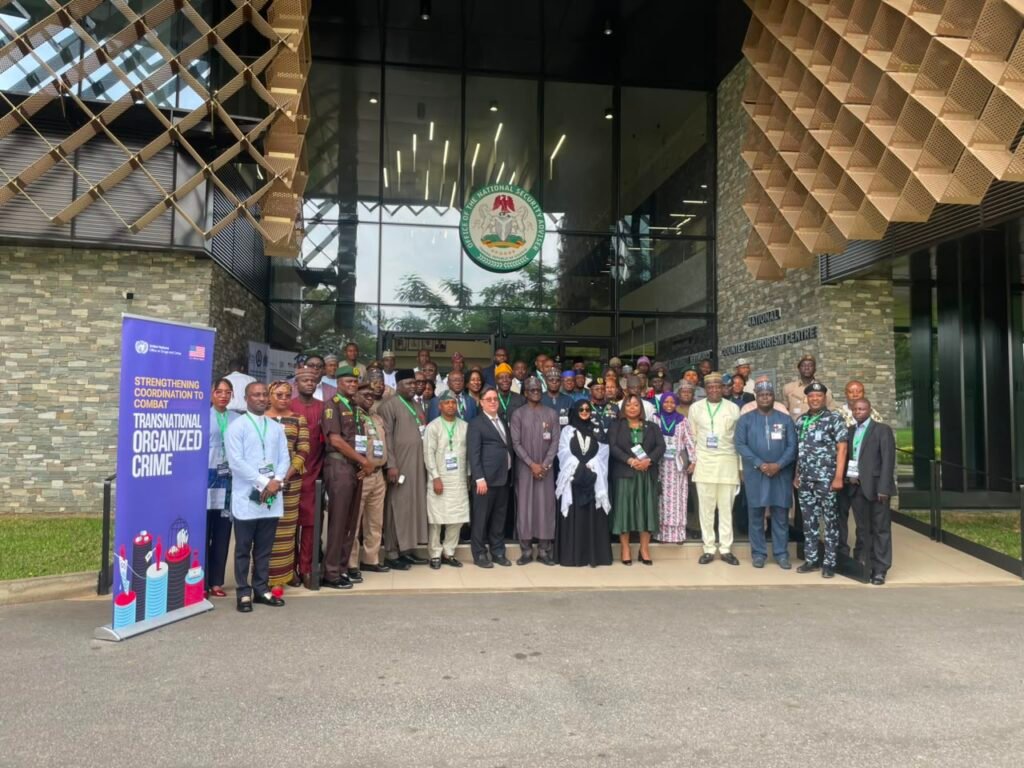
It is also expected to improve public safety, strengthen the criminal justice system, protect victims, curb illicit financial flows, attract investor confidence and reinforce Nigeria’s role in promoting peace and security across West Africa.The strategy, which will be officially launched on August 17, 2026, was presented for validation in Abuja by the National Counter Terrorism Centre (NCTC) under the Office of the National Security Adviser.
Speaking at the event, the National Coordinator of the NCTC, Major General Garba Laka, described organised crime as one of the greatest threats to national, regional and global security, warning that criminal networks have become increasingly sophisticated and interconnected.According to him, terrorism, drug trafficking, cybercrime, trafficking in persons, maritime crime, corruption and illicit financial flows now operate through the same criminal ecosystems, undermining governance, economic growth and public safety.
Laka said although Nigeria has strengthened its legal framework and established institutions such as the Economic and Financial Crimes Commission (EFCC), the National Drug Law Enforcement Agency (NDLEA), the National Agency for the Prohibition of Trafficking in Persons (NAPTIP) and the Nigerian Financial Intelligence Unit (NFIU), the complexity of organised crime demands a unified national response.
“The National Organised Crime Strategy provides an integrated, intelligence-led and evidence-based framework that will strengthen coordination among government institutions, law enforcement agencies, the criminal justice sector, civil society organisations and international partners,” he said.
He noted that the strategy aligns with the UNODC Country Programme for Nigeria (2026–2030), complements Nigeria’s National Counter Terrorism Strategy and the NCTC Strategic Action Plan (2025–2030), and supports the country’s transition into a Regional Centre of Excellence for Counterterrorism in West Africa and the Sahel.Laka urged stakeholders to ensure the document is practical, implementable and nationally owned before its official launch.
Delivering his remarks, the United Nations Office on Drugs and Crime UNODC Representative in Nigeria, Cheikh Ousmane Touire, said criminal networks continue to exploit weak institutions, fragmented information systems and porous borders, making collaboration essential.He explained that defeating organised crime requires a whole-of-government and whole-of-society approach.
According to Toure, the strategy is built on four pillars; Prevent, Pursue, Protect and Promote which focus on addressing the root causes of organised crime, dismantling criminal networks, protecting victims and witnesses, and strengthening cooperation among security agencies and international partners.
Toure stressed that stronger institutions and better coordination would not only improve security but also enhance investor confidence, promote sustainable development and reinforce Nigeria’s leadership role in regional security.
On his part , the United States Government, through the Bureau of International Narcotics and Law Enforcement Affairs (INL) representative Douglas Grane described the strategy as Nigeria’s first comprehensive operational framework for tackling organised crime.He said the framework was developed through months of technical consultations and inter-agency collaboration, funded by the American Government and implemented by UNODC.
He noted that organised crime has become a global challenge linking drug trafficking, cybercrime, human trafficking, illicit finance, arms smuggling and environmental crime, making international cooperation essential.
Grane expressed confidence that effective implementation of the strategy would strengthen Nigeria’s institutions, improve accountability, disrupt transnational criminal networks and enhance security for both Nigeria and its international partners.