
Written by
Isioma Appiah-Yeboah
A coalition of Civil society organisations under the European Union Support to Democratic Governance in Nigeria Phase Two (EU-SDGN II) programme have raised concerns that the N5 million campaign signage levy imposed in Ekiti State could undermine political inclusion and weaken the credibility of the upcoming governorship election.
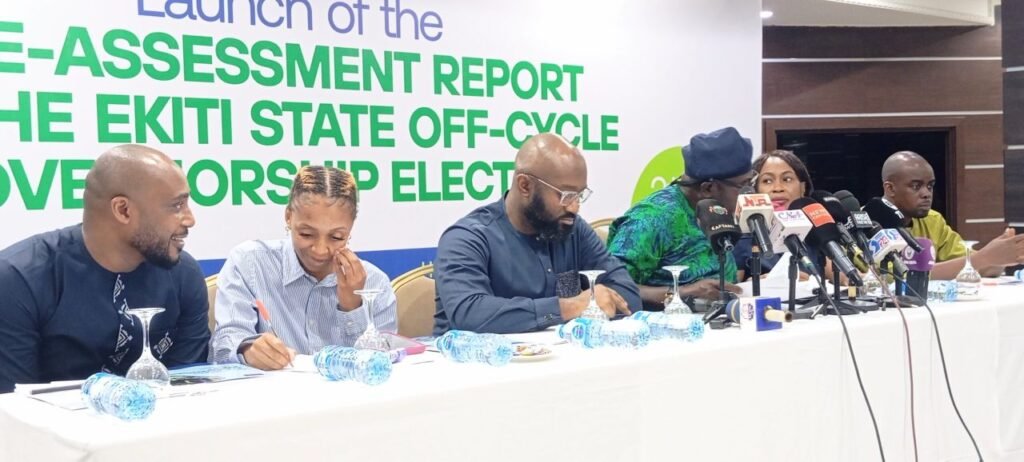
The groups made the observation in a pre-election assessment report presented Thursday during a media briefing in Abuja ahead of the June 20, 2026 Ekiti State governorship poll.
According to the report, the levy imposed by the Ekiti State Signage and Advertisement Agency has created an uneven political environment that disproportionately affects opposition parties, women, youths, and other underrepresented groups with limited financial capacity.
Presenting the report on behalf of the group, Executive Director for the International Press Centre (IPC) Mr Lanre Arogundade, they warned that the development could further shrink political participation and reduce the competitiveness of the election.
“The N5 million campaign signage levy has disproportionately disadvantaged opposition parties,” the report stated, adding that financial barriers continue to limit access to political participation for already marginalised groups.
The report also highlighted concerns over the preparedness of the Independent National Electoral Commission (INEC), noting that readiness across its 16 local government offices stood at just 34 per cent as of April 14, 2026.
While acknowledging ongoing preparations such as Continuous Voter Registration, BVAS inventory checks, network mapping, and stakeholder engagements, the groups said the funding gap and infrastructure deficits remained major concerns.
According to the assessment, INEC has yet to receive election funds, while several local government offices, operational vehicles, and collation centres require urgent rehabilitation ahead of the poll.
The CSOs warned that combining low operational readiness with structural inequalities such as financial barriers to campaigning could undermine voter confidence and election credibility.
The report noted that despite existing legal frameworks promoting inclusion, none of the 13 political parties fielded a female governorship candidate, while no candidate publicly identified as a person with disability.
It added that high nomination costs, entrenched political patronage systems, and informal gatekeeping practices continue to restrict the participation of women, youths, and persons with disabilities in electoral contests.
They further noted that campaign visibility is a critical factor in voter engagement, particularly in grassroots elections where physical outreach and advertising significantly influence public perception.
By raising the cost of visibility, the levy risks limiting opposition messaging and reinforcing perceptions of an uneven electoral playing field.
The report cautioned that such imbalances, combined with limited INEC readiness, could deepen voter apathy if citizens perceive the process as predictable or inaccessible to diverse political voices.
While the pre-election environment remains largely peaceful, the CSOs stressed that peace alone does not guarantee democratic quality, especially where competitiveness and inclusion are in doubt.
They urged stakeholders to ensure a more level playing field that guarantees equal opportunity for all political actors, regardless of financial strength or social status.
The June 20 governorship election is expected to serve as a key test of Nigeria’s new Electoral Act 2026 and a precursor to the 2027 general elections.
The report was jointly signed by the Election Observation Hub, comprising the Centre for Media and Society (CEMESO), ElectHER, International Press Centre (IPC), Nigerian Women Trust Fund (NWTF), TAF Africa, The Kukah Centre, and Yiaga Africa.