
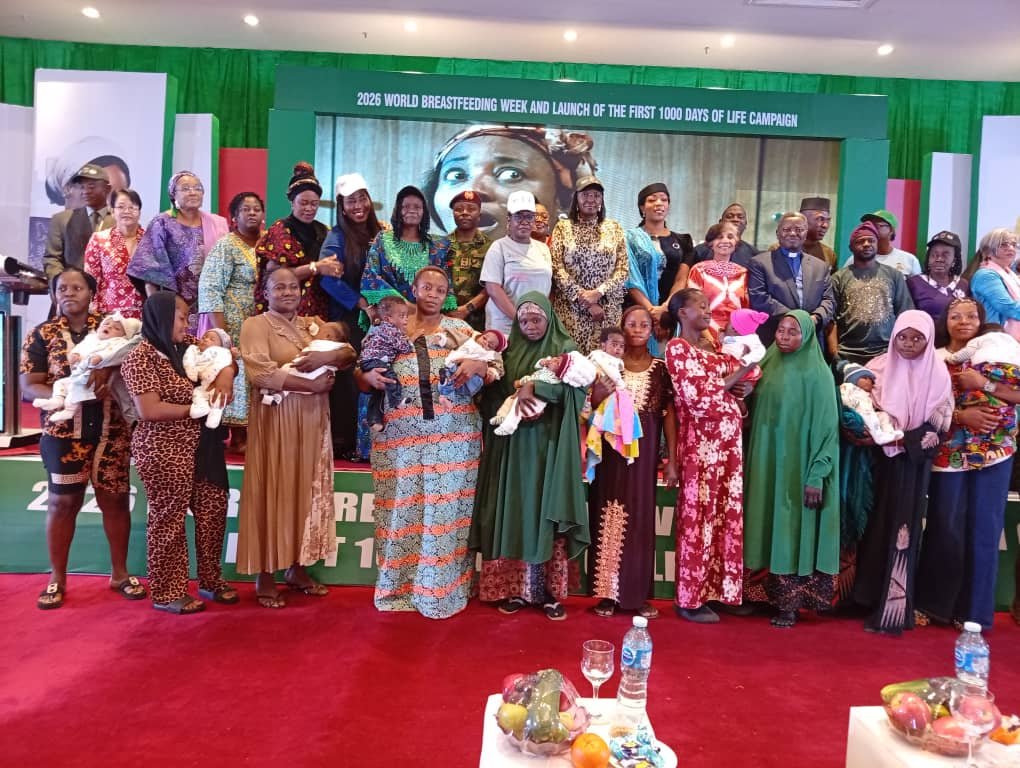
Despite 95.6 per cent of Nigerian children having been breastfed at some point, only 35.5 per cent are put to the breast within the first hour of birth, while just 25 per cent are exclusively breastfed for the first six months.
The figures have renewed concerns over infant nutrition and child survival, as the Federal Government launches a nationwide Social and Behavioural Change campaign focused on the First 1,000 Days of Life, the critical period from pregnancy to a child’s second birthday.
The campaign was launched in Abuja as part of activities marking the 2026 World Breastfeeding Week, with the theme, “Breastfeeding for a Sustainable Start in Life: Strengthen What Works.”
The Federal Ministry of Health and Social Welfare says the first 1,000 days represent a crucial window for shaping a child’s physical growth, brain development, immunity, learning ability and future productivity.
According to data presented at the event, only about 27.7 per cent of children continue breastfeeding between 12 and 23 months, despite the overwhelming evidence of the health and developmental benefits of breastfeeding.
The statistics come against the backdrop of Nigeria’s persistent child malnutrition crisis. The data presented at the event showed that stunting affects about 40 per cent of children, while wasting and underweight remain significant public health concerns.
Why the first 1,000 days matter
Permanent Secretary of the Federal Ministry of Health and Social Welfare, Daju Kachollom, said poor nutrition during the first 1,000 days can have consequences that may be difficult or impossible to reverse.
She said inadequate nutrition during pregnancy and early childhood can affect a child’s cognitive development, weaken immunity and ultimately reduce their potential to contribute productively to the economy.
Kachollom urged mothers to breastfeed their children, stressing that the benefits extend well beyond infancy.
The ministry’s Director and Head of Nutrition, Olufunmilola Adegbite, said the country’s breastfeeding challenge is not simply a question of whether mothers want to breastfeed.
She identified poverty, household income, food insecurity, cultural practices and family influence as some of the factors shaping maternal and infant feeding decisions.
When tradition clashes with nutrition
Adegbite said some mothers are discouraged from consuming nutritious foods during pregnancy because of cultural beliefs.
In some communities, she noted, pregnant women are advised against eating eggs because of the belief that it could affect the shape of the baby’s head.
Other harmful practices continue after delivery, including giving newborns water or other substances before breastfeeding.
Adegbite particularly highlighted the rejection of colostrum, the thick, yellowish first milk produced after childbirth.
Often misunderstood and discarded because of cultural beliefs, colostrum is rich in nutrients and antibodies and provides important early protection for newborns.
She said the new campaign was developed after extensive research, including community visits, behavioural studies and engagement with families to understand what influences maternal and child nutrition decisions.
The campaign will therefore rely less on lectures and more on relatable stories, videos and community-based messaging designed to influence mothers, fathers, grandmothers, traditional and religious leaders.
‘Mothers cannot do it alone’
Health authorities and development partners are also pushing back against the idea that breastfeeding is solely a woman’s responsibility.
The National Primary Health Care Development Agency, NPHCDA, says stronger community support, better trained frontline health workers and breastfeeding-friendly workplaces are essential to improving outcomes.
Representing the NPHCDA Executive Director, Dr Muyi Aina, the agency’s Head of Nutrition, Dr Victoria Adebiyi, called for increased investment in community sensitisation and capacity building for health workers.
She said proven interventions including breastfeeding counselling, baby-friendly health facilities, maternity protection and workplace support must be strengthened rather than abandoned.
The Senior Special Assistant to the President on Public Health, Uju Rochas-Anwukah, described breastfeeding as a national investment, rather than merely a personal choice.
She called for the First 1,000 Days campaign to move beyond Abuja and reach Nigeria’s 774 local government areas, wards, primary healthcare centres and households.
Civil society organisations, including the Civil Society-Scaling Up Nutrition in Nigeria, CS-SUNN, also called on governments, employers, communities, families and development partners to strengthen systems that enable mothers to initiate breastfeeding early, exclusively breastfeed for six months and continue breastfeeding thereafter.
Representing CS-SUNN Executive Secretary, Sunday Okoronkwo, Programme Manager Ridwan Awosanya said breastfeeding should be seen not just as a health intervention, but as an investment in Nigeria’s children, human capital and future prosperity.
UNICEF: Don’t put the burden on mothers
UNICEF Deputy Representative in Nigeria, Rownak Khan, said the figures demonstrate why Nigeria must create an environment where mothers can successfully breastfeed.
Khan described breast milk as a child’s “first vaccine” and one of the most accessible interventions for protecting children against illness and malnutrition.
She said breastfeeding also provides a strong foundation for learning, productivity and human capital development, while generating economic benefits.
According to Khan, global evidence estimates that inadequate breastfeeding contributes to an annual economic loss of about 339 billion dollars, underscoring the wider economic implications of poor breastfeeding practices.
She warned that mothers cannot be expected to succeed without support from families, communities, employers and government.
For working mothers, she called for breastfeeding-friendly workplaces and stronger policies that provide adequate maternity protection.
For mothers outside the formal workforce, she said support must come from households, communities and social networks.
From pregnancy to the second birthday
The World Health Organisation also stressed that the First 1,000 Days approach must begin before a child is born.
The WHO representative, Dr Mya Ngon, said women need adequate antenatal care and nutritional support during pregnancy, followed by appropriate care after childbirth.
She urged families to support exclusive breastfeeding for the first six months, followed by continued breastfeeding alongside appropriate complementary feeding.
The Federal Ministry of Health and Social Welfare says it is also introducing Multiple Micronutrient Supplementation, MMS, for pregnant women as part of efforts to improve maternal nutrition.
The ministry is working to strengthen health-worker capacity, integrate infant and young-child nutrition into routine maternal and child health services, and expand community-based support systems.
The bigger picture
For Nigeria, the challenge is no longer simply getting mothers to breastfeed. It is creating the conditions that allow them to do it early, exclusively and for the recommended duration.
The new First 1,000 Days campaign is therefore designed to shift the conversation from “What should mothers do?” to “What can families, communities, workplaces and government do to support mothers?”
The Federal Government and its partners say strengthening what already works could give millions of Nigerian children a healthier start and, ultimately, improve the country’s human capital and economic future.