
Written by
Ishioma Appiah-Yeboah
In a remote community in Dukku Local Government Area of Gombe State, a pregnant woman faced a frightening reality that thousands of Nigerian women confront every year.
Complications had developed during her pregnancy. The healthcare facility capable of saving her life was more than 180 kilometres away. Every passing minute increased the risk to both mother and child. For many families in similar situations, the journey to care comes too late.
But on this occasion, help arrived.
Through the National Emergency Medical Service and Ambulance System (NEMSAS), she was transported to a facility where she safely delivered triplets.
For health officials, it was one successful intervention among many. For the woman and her family, it was the difference between life and death.
Her story captures a challenge that continues to define healthcare delivery in Nigeria: access.
Across the country, millions of Nigerians live far from quality healthcare services. A pregnant woman in labour, a child battling a severe infection, a farmer injured in an accident, or a victim of a road crash often faces the same obstacle not necessarily the absence of treatment, but the inability to reach it in time.
For decades, delayed emergency response has remained one of the silent causes of preventable deaths in Nigeria. In many communities, healthcare emergencies quickly become transportation emergencies.
On May 29, 2026, the Federal Government signaled a determined effort to change that reality.
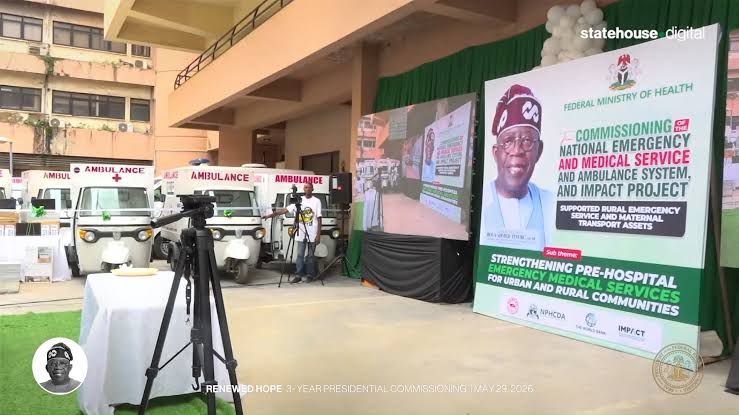
In a landmark event marking the third anniversary of President Bola Ahmed Tinubu’s administration, a series of healthcare projects were commissioned across the country under the Renewed Hope Agenda.
Hosted virtually by the Federal Ministry of Health and Social Welfare, the ceremony represented more than the unveiling of new buildings and equipment. It was a statement of intent, an ambitious effort to strengthen healthcare delivery, expand emergency response systems and improve access to care for millions of Nigerians.
Welcoming President Tinubu and stakeholders from across the health sector, the Minister of State for Health and Social Welfare, Dr. Iziak Adekunle Salako, described the moment as historic.
According to him, the administration’s investments are focused on creating a resilient and people-centred health system that delivers quality healthcare to every Nigerian, regardless of geography or economic status.
For many Nigerians, however, the true significance of these projects will not be measured in the number of facilities commissioned or ambulances deployed.
It will be measured in lives saved.
A Nation Responding to Emergency Care Gaps
Healthcare emergencies rarely announce themselves. A woman may go into labour unexpectedly. A child may develop severe malaria in the middle of the night. A road traffic accident can occur without warning.
In countries with efficient emergency systems, ambulances and trained medical teams often arrive within minutes. In many parts of Nigeria, however, access to emergency care remains a major challenge.
Families frequently rely on motorcycles, private vehicles, commercial transport or improvised means to move critically ill patients to hospitals.
For rural communities, poor road networks often worsen the situation.
In riverine areas, waterways become additional barriers to healthcare access.
These delays can prove fatal.
Health experts often refer to the “three delays” that contribute significantly to maternal and newborn deaths: delays in deciding to seek care, delays in reaching healthcare facilities and delays in receiving treatment after arrival.
The second delay reaching care has remained one of the most difficult challenges to overcome.
It is against this backdrop that the expansion of the National Emergency Medical Service and Ambulance System (NEMSAS) has emerged as one of the centrepieces of the government’s healthcare strategy.
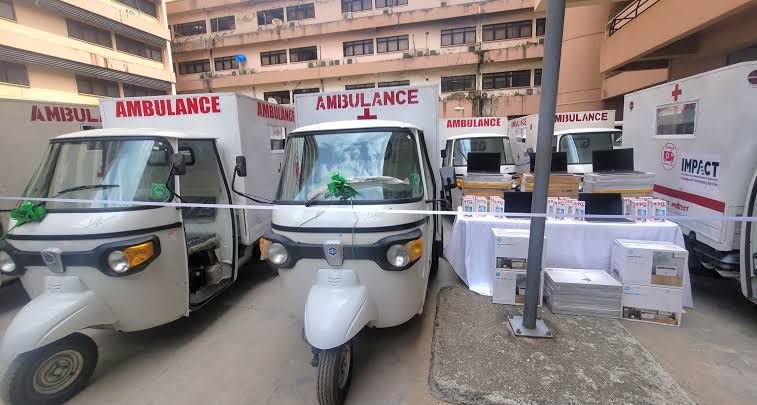
Among the most significant announcements during the commissioning ceremony was the unveiling of 145 tricycle ambulances designed to improve emergency access in hard-to-reach communities.
In addition, six boat ambulances were commissioned for deployment in riverine and coastal regions where conventional ambulances cannot operate effectively.
The government also introduced upgraded emergency communication and dispatch systems aimed at improving coordination and response times nationwide.
While the numbers may appear technical, their impact is deeply human.
For women experiencing childbirth complications in isolated communities, emergency transportation can mean the difference between survival and tragedy.
For accident victims on busy highways, every minute saved can significantly improve the chances of recovery.
For families living in flood-prone communities, boat ambulances may become the critical link between emergency situations and life-saving medical care.
The initiative reflects a growing recognition that healthcare is not simply about building hospitals. It is also about ensuring that patients can reach those hospitals when they need them most.
Bringing Healthcare Closer to Rural Communities
Permanent Secretary of the Federal Ministry of Health and Social Welfare, Daju Kachallom, believes the new ambulance fleet could significantly improve healthcare delivery in underserved communities.
According to her, the ambulances will be stationed at revitalized primary healthcare centres across the country.
Trained drivers will operate the vehicles, while nurses will accompany patients during emergency referrals.
Kachallom also disclosed that emergency contact numbers would be made available through primary healthcare centres to support referrals and facilitate rapid response.
“The ambulances are going down to the rural areas, and they will be stationed at the primary healthcare centres where there are trained drivers, while nurses will accompany the ambulances anytime they need to be moved,” she said.
For communities that have historically struggled with access to healthcare, the intervention offers renewed hope.
Many rural residents continue to face significant barriers in accessing medical services. Long travel distances, transportation costs and poor infrastructure often discourage timely healthcare-seeking behaviour.
The government’s objective is to reduce those barriers by bringing emergency support closer to communities.
Kachallom expressed confidence that the investments would contribute to better health outcomes and further strengthen the health sector before the end of 2027.
She described the improvements witnessed under the Renewed Hope Agenda as evidence of the administration’s commitment to healthcare transformation.
The Story Behind the Statistics
For National Programme Manager of NEMSAS, Demuren Doubra, the impact of emergency transportation is best understood through the stories of the people it serves.
One such story remains stuck in his memory.
He recounted the case of the pregnant woman from Dukku Local Government Area in Gombe State who was transported over 180 kilometres through emergency intervention and later delivered triplets safely.
“This is a woman that would have died because of a gap in transportation,” he said.
The story illustrates the often-overlooked role that transportation plays in health outcomes.
In many emergencies, the challenge is not necessarily the availability of medical expertise but the ability to connect patients to that expertise in time.
According to Doubra, more than 58,000 women and over 2,000 newborns have already benefited from emergency transportation interventions under the programme.
These figures represent thousands of families whose healthcare journeys took a different path because transportation was available when it mattered most.
Yet the challenge remains enormous.
Nigeria continues to carry one of the highest burdens of maternal and newborn mortality globally.
Government figures indicate that approximately 75,000 women die annually from pregnancy-related complications, while around 280,000 newborns die each year.
Many of these deaths are linked to delays in seeking care, reaching healthcare facilities or receiving treatment.
“As NEMSAS, with these facilities and equipment, we are trying to address the delay in reaching care for women and newborns,” Doubra said.
The newly commissioned ambulances are being deployed across 15 states under the World Bank-supported IMPACT Project and are expected to serve local government areas with limited emergency transportation options.
Expanding Healthcare Infrastructure Across Nigeria
While emergency transportation remains a critical component of healthcare reform, it is only one aspect of a broader strategy to strengthen the nation’s health system.
The commissioning event also featured the unveiling of strategic health infrastructure projects spread across Nigeria’s six geopolitical zones.
These projects address different aspects of healthcare delivery, ranging from disease surveillance and emergency preparedness to specialized clinical services.
Among the newly commissioned projects are Emergency Operations Centres in Kano, Sokoto and Katsina States.
These centres are expected to enhance public health preparedness and strengthen the country’s capacity to detect, monitor and respond to disease outbreaks and other health emergencies.
The importance of such facilities has become increasingly evident in recent years as countries around the world continue to strengthen their preparedness following the COVID-19 pandemic.
Another major project commissioned during the event was the Lagos Vaccine Hub.
The facility is expected to strengthen vaccine storage, distribution and logistics management, ensuring more efficient delivery of vaccines across the country.
Vaccination remains one of the most cost-effective public health interventions globally, preventing millions of deaths annually.
By improving vaccine distribution systems, health authorities hope to increase immunization coverage and reduce the burden of vaccine-preventable diseases.
At the community level, upgraded primary healthcare infrastructure in Delta State aims to improve access to basic healthcare services and strengthen frontline healthcare delivery.
Primary healthcare centres remain the first point of contact for millions of Nigerians and are central to achieving universal health coverage.
Strengthening Specialized Healthcare Services
The event also showcased major investments in specialized healthcare facilities designed to address growing demand for advanced medical services.
Among the commissioned projects was the Trauma Centre at Ahmadu Bello University Teaching Hospital, Zaria.
Road traffic accidents, industrial injuries and other trauma-related emergencies contribute significantly to morbidity and mortality across Nigeria.
The trauma centre is expected to strengthen emergency treatment capacity and improve outcomes for critically injured patients.
Also commissioned was the Mental Health Complex at the University of Maiduguri Teaching Hospital.
Mental health has increasingly gained attention within public health discussions, particularly in regions affected by conflict, displacement and economic hardship.
The facility is expected to expand access to psychiatric and psychological care for individuals living with mental health conditions.
In Bauchi, the Infertility and Assisted Reproductive Technology Centre was unveiled, offering new opportunities for couples seeking fertility treatment.
At the University of Uyo Teaching Hospital, a new laboratory complex was commissioned to strengthen diagnostic capacity and support modern healthcare delivery.
Meanwhile, the President Bola Ahmed Tinubu Complex at the Federal Medical Centre, Abuja, was also commissioned as part of ongoing efforts to expand tertiary healthcare services.
Together, these facilities are expected to improve access to specialist healthcare services for millions of Nigerians who previously faced long waiting times, costly referrals or extensive travel for treatment.
Three Years, Hundreds of Projects
According to the Federal Ministry of Health and Social Welfare, more than 100 healthcare projects have either been completed or are underway to commemorate the administration’s third anniversary.
The projects span emergency preparedness, maternal and child healthcare, disease surveillance, diagnostic services and tertiary healthcare modernization.
The scale of investment is reflected in the numbers.
More than 4,000 primary healthcare centres have been revitalized nationwide.
15 new federal tertiary health institutions have been established.
Over 500 high-impact specialist health infrastructure projects have been delivered.
Health insurance coverage has expanded by more than 33 percent within three years.
Collectively, these interventions represent one of the most extensive healthcare infrastructure expansion efforts in recent years.
Expanding Financial Protection Through Health Insurance
Beyond infrastructure development, the government has also focused on improving financial access to healthcare. For millions of Nigerians, healthcare expenses remain a major source of economic hardship.
Out-of-pocket spending continues to account for a significant portion of healthcare financing, often forcing households to make difficult choices between healthcare and other essential needs.
A serious illness can quickly exhaust savings, push families into debt or discourage individuals from seeking timely medical attention.
The reported 33 percent increase in health insurance coverage therefore represents an important development.
Expanding insurance coverage provides greater financial protection and reduces the likelihood that families will experience catastrophic health expenditures.
It also moves Nigeria closer to achieving Universal Health Coverage, a global goal aimed at ensuring that everyone has access to quality healthcare services without financial hardship.
Reducing Medical Tourism Through Local Capacity
For years, many Nigerians travelled abroad in search of specialized medical treatment.
Cancer care, fertility treatment, advanced diagnostics and complex surgical procedures often required expensive overseas trips.
This trend contributed to significant capital flight while highlighting gaps within the domestic healthcare system.
One of the key objectives of the administration’s healthcare reforms has been reversing this pattern by strengthening local capacity.
Investments in specialist facilities, diagnostic centres and advanced treatment infrastructure are intended to provide more Nigerians with access to quality care within the country. For patients and their families, the benefits are substantial.
Receiving treatment closer to home reduces travel costs, minimizes disruption to family life and improves continuity of care. It also helps build confidence in the domestic healthcare system.
Measuring Success Beyond Buildings
While the newly commissioned projects represent visible progress, health experts caution that infrastructure alone cannot transform healthcare outcomes.
The long-term success of these investments will depend on effective implementation, adequate staffing, maintenance, sustainable funding and continuous service delivery.
Ambulances must remain operational. Healthcare facilities must be adequately equipped. Healthcare workers must be supported and retained.
Ultimately, success will not be measured solely by the number of projects commissioned, it will be measured in mothers who survive childbirth, in newborns who reach their first birthdays, in accident victims who receive timely emergency care, in families spared catastrophic healthcare costs.
At its core, the Renewed Hope health agenda seeks to build a system that works for people not only in major cities, but also in rural communities, riverine settlements and underserved regions across the country.
As Nigeria continues its healthcare reform journey, sustaining momentum will remain critical.
However, the message behind the latest healthcare investments is both simple and deeply personal; Quality healthcare should not be a privilege reserved for a few, it should be a right accessible to everyone, everywhere, when it matters most.
And for families like the woman in Gombe who safely delivered triplets after a life-saving emergency referral, that vision is no longer just a policy aspiration, it is already becoming a reality.