

A coalition of election observation organisations has called for the arrest and prosecution of vote buyers, political party agents and financiers involved in electoral offences ahead of Nigeria’s 2027 general elections.
The coalition, under the European Union Support to Democratic Governance in Nigeria (EU-SDGN) Election Observation Hub, said weak enforcement of electoral laws, widespread vote trading and threats to ballot secrecy remained major challenges to credible elections.
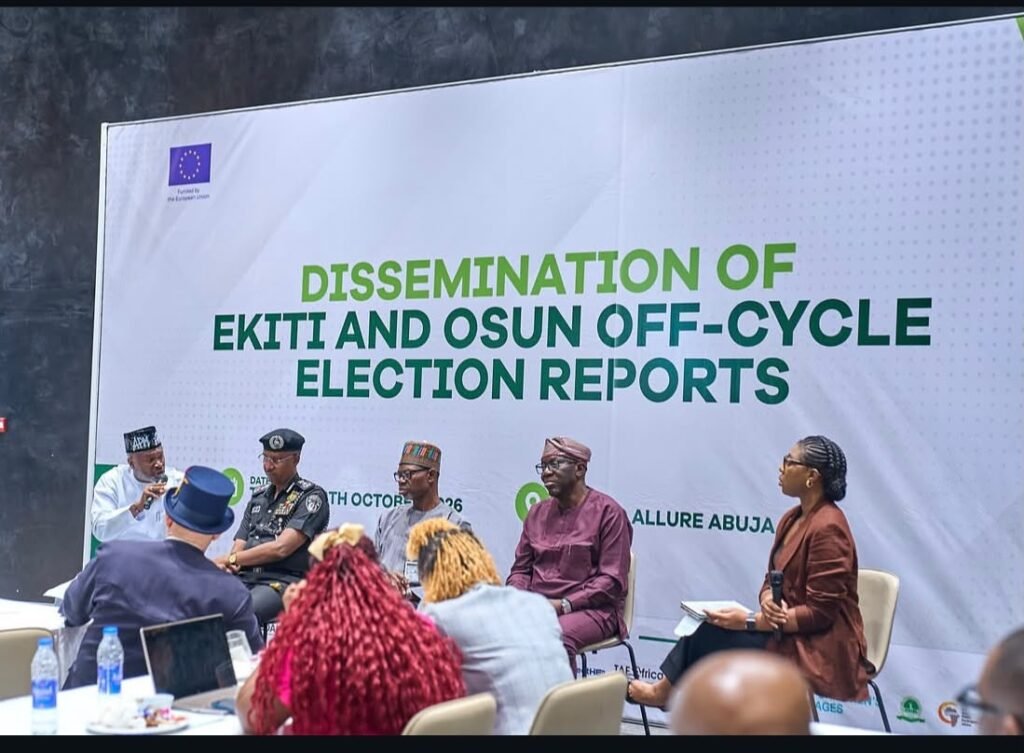
The call was made at the dissemination of the Hub’s post-election observation reports on the 2026 Ekiti and Osun governorship elections in Abuja.
The coalition comprises Yiaga Africa, the International Press Centre, the Centre for Media and Society, the Nigerian Women Trust Fund, TAF Africa and The Kukah Centre.
Presenting the report, titled “From 2026 Ekiti and Osun Governorship Elections to the 2027 General Election: Lessons Learnt and Recommendations for Enhancing the Conduct and Credibility of the 2027 General Election,” Professor Bolade Eyinla, Chief Technical Adviser to former Independent National Electoral Commission (INEC) Chairman, Professor Mahmood Yakubu, said the findings exposed significant weaknesses in the protection of voters’ freedom of choice.
According to the report, political party agents were identified as the main actors in about 90 per cent of 84 verified vote-trading incidents recorded in Ekiti State.
In Osun, vote trading was observed in 69 per cent of the 323 polling units monitored, with 108 incidents documented.
The report also found that voters were frequently required to display their marked ballot papers to party agents for verification before receiving payments ranging from 10,000 naira to 50,000 naira.
Payments were reportedly made at nearby houses, shops, kiosks and hotels outside polling-unit boundaries.
Eyinla expressed concern that no arrests, investigations, charges or prosecutions had been reported at locations where vote buying occurred in either state.
He said the findings suggested that while improvements had been recorded in vote counting and result tabulation, the integrity of elections was increasingly threatened by organised vote trading and the erosion of ballot secrecy.
The report, however, acknowledged improvements in election administration, noting that 98 per cent of polling units in Ekiti and 96 per cent in Osun commenced accreditation and voting by 9:30 a.m.
It also highlighted improvements in the use of the Bimodal Voter Accreditation System (BVAS), while noting that the results declared by INEC fell within the estimated ranges of the Parallel Vote Tabulation conducted independently by Yiaga Africa.
Despite these gains, the coalition identified gaps in results transmission, including the absence of published guidelines on backend validation before results were uploaded to INEC’s Result Viewing Portal (IReV).
It also raised concerns about the non-uploading of ward and local government result forms, EC8B and EC8C, as well as the lack of clear rules on which results should prevail when discrepancies arise.
On inclusion, the report identified inadequate assistive voting devices, including Braille guides and magnifying glasses, and difficulties faced by elderly voters and women wearing face coverings during biometric accreditation.
The coalition further cited allegations of unprofessional conduct, voter intimidation and attacks on journalists involving security personnel, despite the deployment of security and anti-corruption agencies during the elections.
To address these concerns, the organisations urged security agencies to investigate electoral offences, extend enforcement efforts to suspected vote-buying payment centres and publicly disclose the outcomes of arrests and prosecutions.
Political parties and candidates were also urged to comply with electoral laws, avoid the abuse of incumbency, train party agents and promote the participation of women, young people and persons with disabilities.
The coalition called on the judiciary to ensure the timely resolution of pre-election cases, prevent the abuse of court processes and guarantee impartial adjudication of electoral disputes.
Other recommendations included stronger voter education, improved fact-checking, protection for journalists and election observers, an audit of election technology, timely distribution of election materials and better training for ad hoc electoral personnel.
The report also stressed the need for adequate funding, early preparations, stronger protection against cyberattacks and information manipulation, and transparent, traceable transmission of results from polling units to the final declaration.
Earlier, the Executive Director of the Centre for Media and Society, Dr Akin Akingbulu, said the Ekiti and Osun elections should serve as critical learning opportunities ahead of the 2027 general elections.
Akingbulu said the Election Observation Hub monitored the electoral process before, during and after the polls, examining election administration, media coverage, security, political conduct and the participation of women and persons with disabilities.
He said more than 1,400 accredited citizen observers were deployed across the 16 local government areas of Ekiti and the 30 local government areas of Osun to independently monitor the elections and verify results.
According to him, the Hub deployed 598 observers in Ekiti for the June 20 governorship election and 823 in Osun for the August 15 poll.
He stressed that election observation should not be viewed as an accusation against electoral institutions but as an opportunity to identify weaknesses, acknowledge progress and strengthen democratic accountability.
Akingbulu said the elections were the final major tests before the 2027 general elections and that the lessons drawn from them should inform preparations for a more credible and inclusive electoral process.
He added that Nigerians would expect elections that were not only well managed but also protected, with accurate and transparent results, effective ballot secrecy and an environment in which journalists and observers could work without fear or obstruction.
The coalition said the recommendations were intended to help electoral institutions, security agencies, political parties, the media and civil society address outstanding challenges before the 2027 polls.