

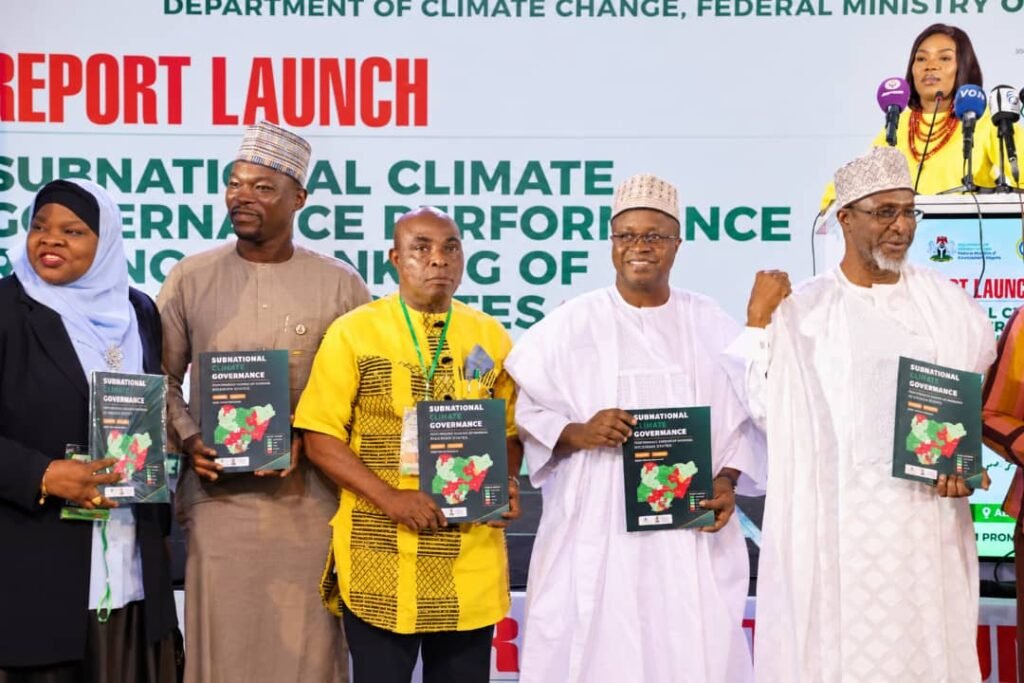
The Federal Government has launched the third edition of the Subnational Climate Governance Performance Rating and Ranking Report, urging state governments to move beyond climate policies and deliver measurable results through increased investment, stronger institutions and effective implementation.
The Minister of Environment, Balarabe Abbas Lawal, made the call in Abuja during the launch of the report, organised by the Society for Planet and Prosperity.
Lawal said Nigeria’s success in tackling climate change would depend largely on the ability of state governments to translate national commitments into practical action at the state and community levels.
He described climate change as a development, economic, social and security concern, noting its growing impact on flooding, extreme heat, drought, agriculture, food systems, water resources and livelihoods.
According to the minister, the latest edition of the report shifts attention from the establishment of climate institutions and policies to implementation, investment and measurable outcomes.
He urged governors to make climate action an integral part of their development priorities by strengthening relevant institutions, incorporating climate considerations into state plans and budgets, and creating an enabling environment for climate finance, private investment and strategic partnerships.
The minister also called on states to develop bankable climate projects and accelerate the implementation of adaptation and mitigation measures.
He said the ranking should serve as more than a scorecard, describing it as a strategic tool for identifying governance gaps, tracking progress and strengthening accountability.
Lawal commended states making progress in climate governance and encouraged them to deepen implementation and share successful approaches. He also urged states still developing their climate governance systems to use the report to identify areas for improvement rather than view the ranking as a basis for stigmatisation.
He reaffirmed the Federal Government’s commitment, under President Bola Tinubu’s Renewed Hope Agenda, to supporting states through technical assistance, capacity development and collaboration.
The minister further called on development partners, financial institutions, the private sector, academia and civil society organisations to support efforts to move climate action from policy commitments to investment and implementation.
He stressed that climate interventions must respond to the needs of local communities, with women, young people, farmers, businesses and vulnerable groups actively involved in building climate resilience.
Lawal said effective state-level implementation was essential to achieving Nigeria’s climate commitments, including its Nationally Determined Contributions and National Adaptation Plan.
He urged stakeholders to use the third edition of the report to strengthen accountability, accelerate climate action and promote sustainable development across the country.