


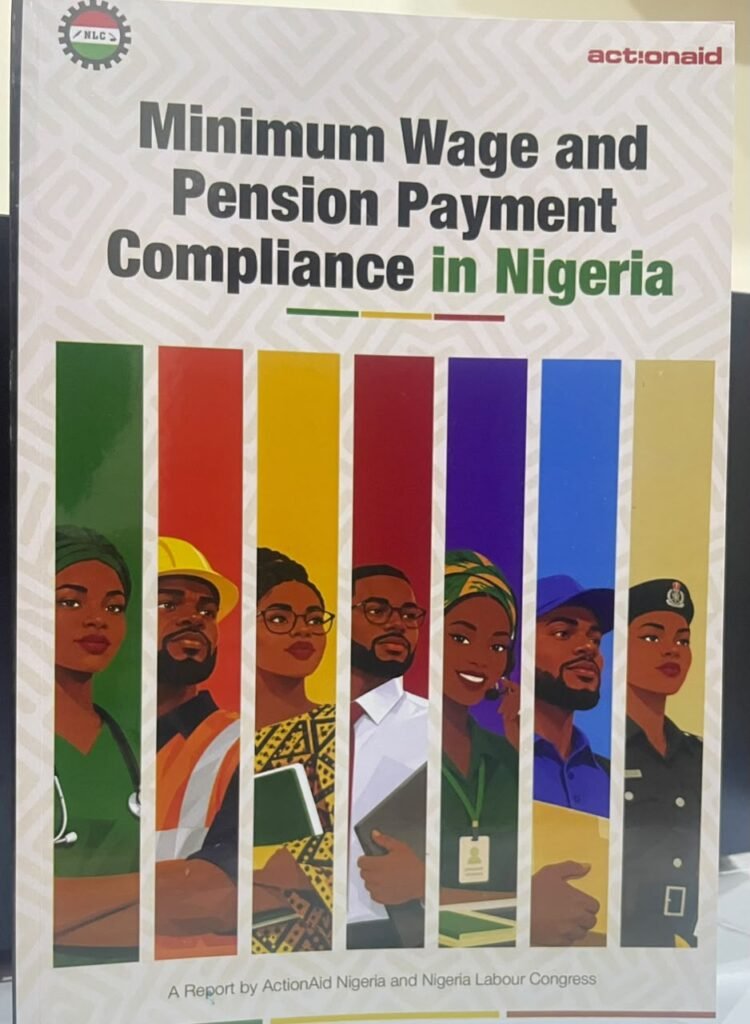
A new research report has exposed significant gaps in the implementation of Nigeria’s national minimum wage, revealing that compliance is nearly 100 per cent at the federal level but below 67 per cent among state governments and 48 per cent among local governments.
The report also estimates that states owe 626.8 billion naira in pension and gratuity arrears, despite rising allocations from the Federation Account Allocation Committee (FAAC).
The findings were presented at the launch of a research report on minimum wage and pension payment compliance by ActionAid Nigeria and the Nigeria Labour Congress (NLC), which also outlined joint advocacy priorities to improve workers’ welfare and strengthen compliance with existing laws.
Nigeria increased its national minimum wage from 30,000 naira to 70,000 naira in 2024, representing an increase of approximately 133 per cent.
However, the report highlights a significant gap between the wage provided for by law and its actual implementation across the different levels of government.
It identifies delayed adoption, funding constraints, inflationary pressures and uneven coverage of worker categories as major barriers to effective compliance.
The report further warns that wage increases can be eroded by rising costs of basic necessities, reducing workers’ purchasing power despite adjustments to their nominal earnings.
Speaking at the event on Tuesday in Abuja, NLC President Joe Ajaero called for an early commencement of negotiations for a new minimum wage, arguing that rising living costs have substantially weakened the value of the current 70,000-naira wage.
Ajaero said increasing wages alone would not resolve workers’ financial difficulties without measures to address inflation and the declining value of the naira.
He also called for a corresponding minimum pension, expressing concern that some retirees receive monthly payments as low as 20,000 to 30,000 naira.
The labour leader urged the government to introduce measures to ensure that pensioners receive adequate payments, including those under the contributory pension scheme.
He further called for interventions to cushion the impact of rising living costs on workers while preparations begin for the next minimum wage negotiations.
Earlier, Country Director of ActionAid Nigeria, Andrew Mamedu, said the research was conducted to assess compliance with the current minimum wage and identify lessons that could guide future wage adjustments.
Mamedu explained that the research involved consultations with workers, pensioners, employers, government representatives and relevant agencies across the country.
He noted that some state and local governments had delayed implementing approved wage adjustments or failed to comply fully with the provisions of the minimum wage law.
The report also highlighted concerns about the implementation of consequential adjustments across salary grades, which are intended to reflect wage increases throughout the salary structure.
The Country Director also called on state governments to prioritise workers’ welfare by fully implementing the national minimum wage for all eligible categories of workers, clearing outstanding pension and gratuity arrears, and complying with the Pension Reform Act 2014.
The organisation stressed the need to translate the report’s findings into concrete policy actions, with stronger accountability mechanisms to ensure that workers and retirees receive their lawful entitlements.
The research examined the history of minimum wage adjustments, the cost of living, inflation trends and the difference between nominal wages and their actual purchasing power.
The ActionAid Nigeria and the NLC say the findings will inform joint advocacy efforts to strengthen minimum wage compliance, improve pension payments and promote decent working conditions across the country.