

With the 2027 general elections only months away, the European Union Support for Democratic Governance in Nigeria, EU-SDGN II, has raised concerns over the cost, transparency and inclusiveness of political party nominations, saying weaknesses in the 2026 primaries could affect confidence in the choices presented to voters.
The concerns are contained in a new report, “Before the Ballot,” which assesses the conduct of the 2026 political party primaries and the candidate lists published by the Independent National Electoral Commission, INEC, on September 12.
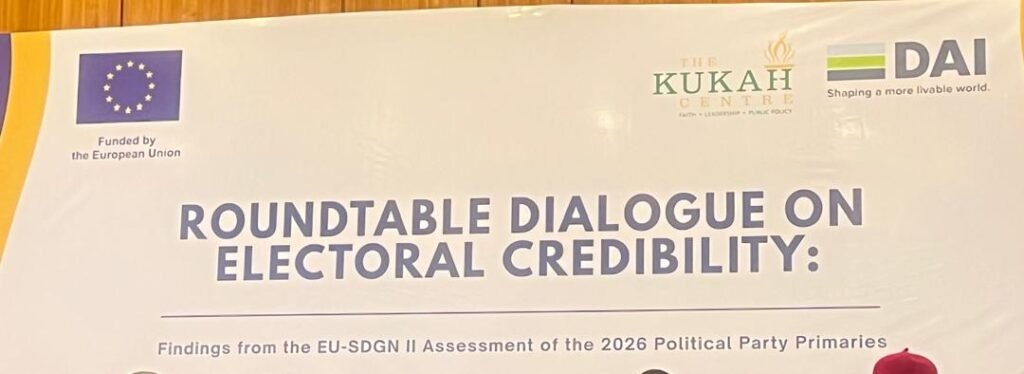
The findings were presented in Abuja at a Roundtable Dialogue on Electoral Credibility: Findings from the EU-SDGN II Assessment of the 2026 Political Party Primaries.
The assessment was conducted by electoral experts Ralph Michael Peters and Florence Ganoux, who observed primaries in selected locations across the country in May and June, while also analysing media reports and interviewing political stakeholders and analysts.
Presenting the report, Peters said political party primaries should not be treated simply as an internal affair of political parties because they determine who gets to contest elections and, ultimately, the choices available to voters.
He said the integrity of the electoral process therefore begins well before election day.
The report found that reforms introduced for the 2026 primaries made party nominations more formal through measures such as digital membership registers, more documented procedures and the use of direct primaries and consensus arrangements.
However, the assessment found that these changes did not necessarily make nominations more democratic or easier to verify.
According to the report, control over critical stages of the process remained concentrated around party structures, including access to nomination forms, screening and clearance, membership records, accreditation, venues, internal appeals and certification.
The experts said this created opportunities for gatekeeping and left some nomination decisions opaque to aspirants, party members and other stakeholders.
Cost of nomination
The report identified the cost of obtaining nomination forms as one of the barriers to wider participation in party politics.
It noted that fees were particularly high in parties with strong representation in the National Assembly, potentially limiting the ability of less financially advantaged aspirants to compete.
Women and persons with disabilities were also identified among those who could face greater barriers to participation.
The assessment further found that screening processes were not always transparent, with reasons for clearing or disqualifying aspirants not consistently communicated to those affected.
INEC monitoring and enforcement
The report also examined INEC’s role in monitoring the primaries.
The experts said INEC officials were present at several venues observed during the exercise and gathered information on the conduct of the primaries.
However, they said the information collected largely remained internal, making it difficult to determine whether identified breaches resulted in corrective action.
The report also identified gaps in the legal framework around sanctions for violations of party-primary regulations, noting that some requirements did not have clearly defined consequences for non-compliance.
Access to information
Another concern was unequal access to information during the nomination process.
The assessment found instances where information about the venue, timing and arrangements for direct primaries was allegedly not communicated equally to all aspirants.
The experts said this could prevent some aspirants and their agents from participating effectively.
They cited an observed governorship direct primary in Ibadan North, Oyo State, where the venue was changed on the day of the exercise.
According to Peters, some party members went to the original venue and only later learnt that the exercise had moved to another location.
He said the incident demonstrated that timely and equal access to information is essential for effective participation in party primaries.
Need for a verifiable nomination trail
The report recommends a clearer and verifiable trail through which the emergence of every candidate can be followed from membership and accreditation, through the primary and possible appeals, to certification and the final candidate list published by INEC.
The experts said such a trail would help voters understand how candidates eventually appearing on the ballot were selected.
They also called for greater cooperation between INEC and political parties, arguing that regular engagement could help resolve disputes before they escalate into prolonged litigation.
The assessment, however, stressed that the weaknesses identified in the nomination process do not by themselves determine the credibility of the 2027 elections.
It said there is still room for political parties, INEC, the courts and other stakeholders to address the identified gaps before the elections.
The report ultimately places the spotlight on an often overlooked stage of the electoral process the period before voters get to the ballot box, when political parties decide who will be asking for their votes.